Showing posts with label Musicians. Show all posts

Saturday, December 25, 2010

"My Head Is My Only House Unless It Rains"

Don Glen Vliet (January 15, 1941 – December 17, 2010)
Photo from: 
Beefheart is gone, but his influence lives on. 
By Jeff Miers


{http://www.buffalonews.com/entertainment/gusto/jeff-miers-sound-check/article292257.ece)

From: http://en.wikipedia.org/wiki/Captain_Beefheart

"Don Van Vliet (pronounced /væn ˈvliːt/), born Don Glen Vliet[3] (January 15, 1941 – December 17, 2010) was an American musician, singer-songwriter and artist best known by the stage name Captain Beefheart. His musical work was conducted with a rotating ensemble of musicians he called The Magic Band, active between 1965 and 1982, with whom he recorded 12 studio albums. Noted for his powerful singing voice with its wide range,[4] Van Vliet also played the harmonica, saxophoneand numerous other wind instruments. His music blended rock, blues and psychedelia with free jazz, avant-garde and contemporary experimental composition.[5] Beefheart was also known for exercising an almost dictatorial control over his supporting musicians."


From: http://blog.beefheart.com/2010/12/john-frenchs-tribute-to-don-van-vliet.html
John French's tribute to Don Van Vliet

While touring in the UK in 1975, there was a concert we played in a medium sized hall somewhere lost in time, where a bus brought in a group of about 16 wheelchair-bound individuals. After the concert ended, we were headed for our bus when Don stopped and watched as the handicapped individuals were tediously loaded one by one onto their bus. Our bus driver, a bit impatient, called out that we could go, but Don refused to budge. “I’m not leaving until they do. They had the patience to go through all this trouble to come see me, and I’m going to show them the same courtesy.”

Tuesday, December 14, 2010

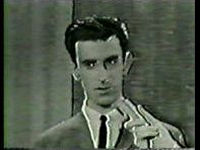
Frank Zappa on "The Steve Allen Show" (first aired on March 27, 1963)

A 22 years old Frank Zappa on "The Steve Allen Show" plays "the bicycle".

]


Monday, April 28, 2008

Frank Zappa

Before
After

Frank Zappa was born in Baltimore, Maryland, on December 21, 1940 to Francis Zappa (born in Partinico, Sicily) who was of Greek-Arab descent, and Rose Marie Colimore who was of three quarters Italian and one quarter French descent. He was the oldest of four children (two brothers and a sister). During Zappa's childhood, the family often moved because his father, a chemist and mathematician, had various jobs in the US defense industry. After a brief period in Florida in the mid-1940s, the family returned to Edgewood, Maryland where Zappa’s father got a job at the Edgewood Arsenal chemical warfare facility at nearby Aberdeen Proving Ground. Due to the home's proximity to the Arsenal which stored mustard gas, Zappa's father kept gas masks on hand in case of an accident. This had a profound effect on the young Zappa: references to germs, germ warfare and other aspects of the defense industry occur throughout his work.
As a child, Zappa was often sick, suffering from asthma, earaches and a sinus problem. A doctor treated the latter by inserting a pellet of radium on a probe into each of Zappa's nostrils. Nasal imagery and references would appear both in his music and lyrics as well as in the collage album covers created by his long-time visual collaborator, Cal Schenkel. While little was known at the time about the potential dangers of living close to chemicals and being subjected to radiation, it is a fact that Zappa's illnesses peaked when he lived in the Baltimore area.
In 1952, his family relocated mainly because of Zappa's asthma. They settled first in Monterey, California, where Zappa’s father taught metallurgy at the Naval Postgraduate School. Shortly thereafter, they moved to Claremont, then again to El Cajon before once again moving a short distance, to San Diego. During this period, his parents bought a record player, one event initiating Zappa’s interest in music, as he started collecting records. Television also exerted a strong influence, as demonstrated by quotations from show themes and advertising jingles found in some of his later work.
(Wikipedia)