
Sunday, January 26, 2014
Sunday, December 30, 2012


Saturday, December 25, 2010
"My Head Is My Only House Unless It Rains"
Don Glen Vliet (January 15, 1941 – December 17, 2010)

Photo from:
Beefheart is gone, but his influence lives on.
By Jeff Miers
{http://www.buffalonews.com/entertainment/gusto/jeff-miers-sound-check/article292257.ece)
"Don Van Vliet (pronounced /væn ˈvliːt/), born Don Glen Vliet[3] (January 15, 1941 – December 17, 2010) was an American musician, singer-songwriter and artist best known by the stage name Captain Beefheart. His musical work was conducted with a rotating ensemble of musicians he called The Magic Band, active between 1965 and 1982, with whom he recorded 12 studio albums. Noted for his powerful singing voice with its wide range,[4] Van Vliet also played the harmonica, saxophoneand numerous other wind instruments. His music blended rock, blues and psychedelia with free jazz, avant-garde and contemporary experimental composition.[5] Beefheart was also known for exercising an almost dictatorial control over his supporting musicians."
From: http://blog.beefheart.com/2010/12/john-frenchs-tribute-to-don-van-vliet.html
John French's tribute to Don Van Vliet
While touring in the UK in 1975, there was a concert we played in a medium sized hall somewhere lost in time, where a bus brought in a group of about 16 wheelchair-bound individuals. After the concert ended, we were headed for our bus when Don stopped and watched as the handicapped individuals were tediously loaded one by one onto their bus. Our bus driver, a bit impatient, called out that we could go, but Don refused to budge. “I’m not leaving until they do. They had the patience to go through all this trouble to come see me, and I’m going to show them the same courtesy.”
Tuesday, December 14, 2010
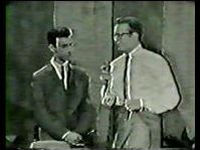
Frank Zappa on "The Steve Allen Show" (first aired on March 27, 1963)
A 22 years old Frank Zappa on "The Steve Allen Show" plays "the bicycle".






]

Tuesday, July 14, 2009

Monday, April 27, 2009
Évariste Galois

 Notes
Évariste Galois (IPA: [evaʁist ɡaˈlwa]; October 25, 1811 – May 31, 1832) was a French mathematician born in Bourg-la-Reine. While still in his teens, he was able to determine a necessary and sufficient condition for a polynomial to be solvable by radicals, thereby solving a long-standing problem. His work laid the foundations for Galois theory, a major branch of abstract algebra, and the subfield of Galois connections. He was the first to use the word "group" (French: groupe) as a technical term in mathematics to represent a group of permutations. A radical Republican during the monarchy of Louis Philippe in France, he died from wounds suffered in a duel under murky circumstances at the age of twenty.
(Wikipedia)
Wednesday, March 25, 2009


Friday, February 27, 2009
Carl Friedrich Gauss, princeps mathematicorum

Johann Carl Friedrich Gauss (IPA: /ˈɡaʊs/, German: Gauß, Latin: Carolus Fridericus Gauss) (30 April 1777 – 23 February 1855) was a German mathematician and scientist who contributed significantly to many fields, including number theory, statistics, analysis, differential geometry, geodesy, electrostatics, astronomy, and optics. Sometimes known as the princeps mathematicorum (Latin, usually translated as "the Prince of Mathematicians", although Latin princeps also can simply mean "the foremost") and "greatest mathematician since antiquity", Gauss had a remarkable influence in many fields of mathematics and science and is ranked as one of history's most influential mathematicians.
Gauss was a child prodigy, of whom there are many anecdotes pertaining to his astounding precocity while a mere toddler, and made his first ground-breaking mathematical discoveries while still a teenager. He completed Disquisitiones Arithmeticae, his magnum opus, in 1798 at the age of 21, though it would not be published until 1801. This work was fundamental in consolidating number theory as a discipline and has shaped the field to the present day.
(Wikipedia)
Saturday, January 31, 2009

Saturday, May 17, 2008


Friday, May 16, 2008


Subscribe to:
Posts (Atom)


